
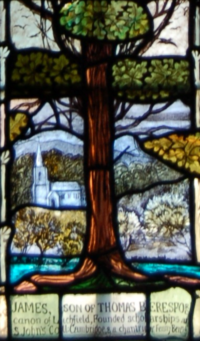
One of the attributes of early members of our family was the encouragement of learning, however one family member who did more than anyone to encourage this was Canon James Beresford, youngest son of Thomas and Agnes. Born around 1455 Canon James commenced 4 years of study in canon law at St John’s College, Cambridge in 1470 followed by 6 years elsewhere and also served as a tutor at the home of Sir John Leak at Sutton. He was Senior Deacon at Norwich in 1481, Vicar of Chesterfield in 1484, Rector of Matlock in 1497, Vicar of Wirksworth in 1504 then Canon and Prebendary at Lichfield Cathedral in 1507 where he was buried on the 13th July 1520. Apart from his remarkable clerical duties Canon James did a profitable deal in timber and the wealth he acquired was spent on charitable causes. Amongst other things he founded two fellowships and two scholarships in St John’s College, Cambridge.
The Foundation Deed made on the 12th February 1520 between the Master, fellows and scholars of the College, the Dean and Chapter of Lichfield Cathedral and Canon James, covenanted that the said James for him and Lawrence his late brother, deceased, should have two fellows and two scholars in the said college forever, providing always that the said fellows and scholars should be of the name and kindred of the said James Beresford and secondarily of the parishes of Chesterfield, Wirksworth and Ashbourne in the county of Derby or Alstonefield in the county of Stafford. The said fellows and scholars were to have their chambers within the same college and to be discharged of cook and butlers wages together with meat and drink and every of them to have £3-6s-8d yearly for their subsidy. For funding of the necessary expense Canon James paid to the master, fellows and scholars £400 with which the master, fellows and scholars had purchased lands and tenements to the yearly value of £20 to the use of the the said master, fellows and scholars for that purpose.
Canon James’ far-sighted benefaction to aspiring Beresford scholars served the family well for some 340 years until in 1860 new statutes for the college were introduced creating new scholarships out of a general fund and all those depending on name and kindred of founders except certain ones linked to particular schools ceased. Fellowships were also reformed in the same way.